

Common IELTS Writing Task 2 Mistakes That Reduce Your Band Score
To get a band score of 7 or 8(+) for IELTS Writing Task 2 you will need more than just good grammar. Many test-takers have a strong vocabulary and grammatical skill, however they still lose valuable scoring in this section of the test due to making common errors when doing so.
Task 2 is worth two times more than Task 1; therefore avoiding common errors can create a large difference in your IELTS Band (overall).
Whether aiming for Band 7, 8 or above – knowing what IELTS Examiners are looking for is the first step towards success.
In this article we will identify the most common errors test-takers make when completing Writing Task 2 and give you examples of how to write an effective writing task 2 essay that meets all the criteria for scoring well.
What is IELTS Writing Task 2?
Your task for IELTS Writing Task 2 is to complete an essay that contains a minimum of 250 words in reply to a specific question, which could be:
- Expressing your opinion
- Discussing both sides of the argument
- Solving a problem
- Explaining pros and cons
- Answering a simple question.
An estimated 40 minutes should be set aside to complete this task. The mark for your response will be determined by using four assessment criteria:
- Task Response
- Coherence/Cohesion
- Lexical Resources
- Grammar Range and Accuracy
When you have a clear idea of how these elements will be assessed, then you can avoid making errors that will reduce your mark significantly.
1. Not Answering the Question Properly
Misunderstanding the essay question is one of the most common mistakes made by candidates. Most students provide knowledge instead of responding to what the examiner wanted.
For example, if your question says,
“do you agree or disagree?”
Don’t do both for equally as long; instead:
- You should answer with a straight “yes” or “no” according to what you feel is correct.
- You should support your assertion with examples or other reasons, throughout the essay.
- The writer should be consistent.
Spend time analyzing all aspects of the question before you begin writing: 5-10 minutes.
2.Writing Less Than 250 Words
A minimum of 250 words constitutes the word count requirement for IELTS Writing Task 2.
If you do not write the minimum required amount of words, then it is likely that:
- Your ideas are underdeveloped
- Your ideas are poorly developed
- You will receive a low Task Response score
You should also not write too much (long) in relation to the maximum allotment amount (some students aim for 260 to 290 words) so concentrate on writing quality over quantity.
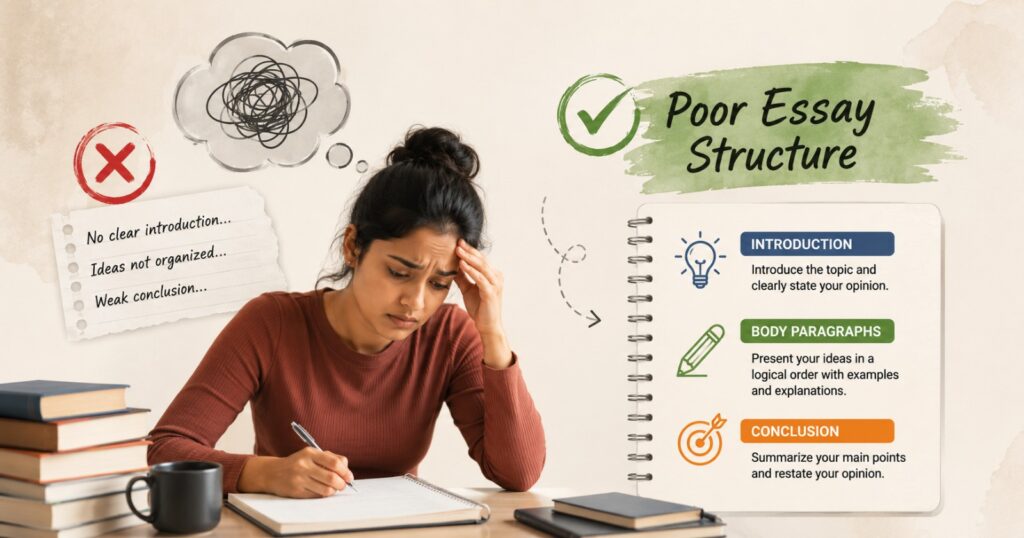
3. Poor Essay Structure
The simplest organization method starts with:
An introduction
- Paraphrase The Question
- Present An Opinion/Outline Your Answer
Body Paragraph 1
- Main Idea
- Explanation
- Example Of Main Idea
Body Paragraph 2
- Second Idea
- Explanation
- Example Of Second Idea
Conclusion
- Summarise The Main Points
- Restate Opinion/Answer The Question
A clear structure will add to the coherence and cohesion of your writing.
4. Memorizing Essays
Some candidates memorize essays expecting similar questions in the exam.
This is risky because:
- Examiners recognize memorized content.
- It may not answer the question correctly.
- It limits flexibility.
Instead, learn essay structures, linking words, and useful vocabulary that you can adapt to different topics.
Certain applicants prepare by memorizing essays anticipating equivalent questions on their test.
This can be an especially risky strategy due to:
The fact that exam markers can identify if something has been memorised;
The potential of those answers not being the correct answer to the question;
And because of the restriction on flexibility.
By learning essay structures, linking phrases, and general vocabulary you can then adapt to any essay topic.
5. Overusing Complex Vocabulary
A lot of students think that if they use tough words then they will get higher scores. In reality, using high-level vocabulary inappropriately actually decreases your Lexical Resource score. Instead, you should:
- Choose the right word for the situation.
- Use expressions that sound natural to native speakers.
- Do not use more sophisticated vocabulary when it does not fit the context.
Using proper English that is less difficult is better than using more complex, but incorrect, English.
6. Ignoring Grammar Accuracy
Grammar has a lot of influence in how you score in writing, so therefore, you want to avoid common mistakes in grammar such as:
- Incorrect verb tense
- Subject and verb not agreeing
- Using articles incorrectly
- Sentence fragments
- Run-on sentences
Be sure to allow yourself a few minutes to review your written response before submitting it for the writing portion of the exam.
7. Weak Supporting Examples
When creating an idea, you must provide an example of how you are able to demonstrate and illustrate the idea.
For example:
“We can use technology and improve education.”
If we use technology to improve the educational process, students will benefit from increased opportunities to learn through virtual classrooms and access to resources. Therefore, we can improve the accessibility of education on a global scale.
8. Using Informal Language
Take note that IELTS Writing Task 2 is an academic form of writing.
Do not use:
- Short forms (e.g. don’t, can’t).
- Slang.
- Informal expressions.
- Texting language.
Use more formal ways to express yourself;
- do not.
- cannot.
- also.
- and.
- therefore.
Having a formal tone creates an academic style of writing.
9. Poor Paragraphing.
Long paragraphs can make your papers difficult to understand.
Each paragraph should focus on a single idea.
Each logically structured paragraph should contain the following parts:
- Topic Sentence
- Supporting Discussions
- An example
- Conclusory Statements
Organising paragraphs this way creates improved readability and fluidity overall throughout the written work.
10. Misusing Linking Words
A large number of students use excessive amounts of connectors, including:
- In addition
- On the other hand
- Consequently
In addition to these overused connectors, overusing them may cause you to sound unnatural in your writing.
Use these connectors only when they are needed.
Instead of putting connectors between your sentences, concentrate on the logical flow of your writing.
11. Spending Too Much Time on Task 1
IELTS Writing Task 2 has more points than Task 1, which means that time management is vital. It is suggested that you spend the following number of minutes on each task:
- Task 1 — 20 minutes
- Task 2 — 40 minutes
Many students spend too much time writing Task 1 and rush their way through Task 2 resulting in lower-quality essays.
12. Not Planning Before Writing
Failing to Plan
It can cause issues when you jump into writing immediately.
- All of your ideas will be repetitive.
- Your essay might be poorly organized.
- You might have weak arguments in your essay.
However, spending 5 minutes on planning will help you:
- Your opinion
- Two clear reasons
- Two supporting examples
- Your essay’s structure
Planning will assist you in saving time and create a better outcome.
Tips to Score Band 7+ in IELTS Writing Task 2
Use these strategies to boost your IELTS score:
- Read the Essay Question Carefully.
- Practice Writing Essays Regularly.
- Examine High-Scoring Sample Answers.
- Increase Your Grammar/Vocabulary Skills.
- Learn Formal Academic Style & Structure.
- Use Clarity Not Complex Words.
- Provide Example(s) To Back Up Each Idea.
- Double Check Your Work Before Submitting.
- Efficiently Manage Time.
Seek Feedback From An Experienced IELTS Trainer.

How Edufolks Helps You Excel in IELTS Writing Task 2
Preparing independently for the IELTS can be complex, particularly in regards to writing. The Edufolks’ IELTS coaching program has been developed to inform and instruct students regarding what examiners expect from students, as well as to provide students with the skills needed to achieve higher band scores on their IELTS.
The Edufolks IELTS preparation program includes the following:
- Experienced IELTS trainers
- Personalized writing feedback
- Essay correction sessions
- Grammar improvement classes
- Vocabulary enhancement classes
- Mock IELTS tests
- Time management strategies
- Individual performance reviews of practice tests
Whether you plan to study abroad, immigrate or find a job; Edufolks offers you practical advice to help you succeed with the IELTS Exam.

Conclusion
To write well on IELTS writing task 2 will require you only to have a thorough understanding of what is being asked of you, clearly organize your ideas using good grammar, and support your points with evidence to back them up, not how complex a word is used or the length of your written essay.
By consistently practising and avoiding these mistakes you will greatly improve on how well you write; therefore, greatly increase your chances of getting the IELTS band score that you are aiming for.
If you would like some assistance from a professional IELTS coaching service who offers the following: expert guidance, individualised feedback, and evidence based preparation strategies, Edufolks can help you gain confidence when sitting your exam.
Practice now, learn from your mistakes, then you will be that much closer to achieving your desired IELTS score.
FAQs:
The IELTS Writing Task 2 is the second section of the IELTS Writing examination offered to test candidates' writing ability through composing 250-word essays in response to a specified prompt. This essay is worth twice as much as Task One towards the final Writing band.
Your essay will be assessed on four parameters:
- a) Task Response
- b) Coherence and Cohesion
- c) Lexical Resource
- d) Grammatical Range and Accuracy
Each parameter has an equal impact on your Writing Task 2 score.
You must write no fewer than 250 words. Most candidate writers find a range of 260-290 will allow for an adequate amount of explanation of ideas without having to "fill-up" sections with extraneous material.
Yes. Candidates may use personal or hypothetical examples if they substantiate the rationale of their arguments and/or are germane to the essay topic.
Common mistakes in IELTS Writing Task 2 include: misunderstanding the question; not having a coherent essay structure; writing with grammatical mistakes; using poor examples; not using sufficient words; producing an essay that is too informal in tone; and/or failing to proofread.