
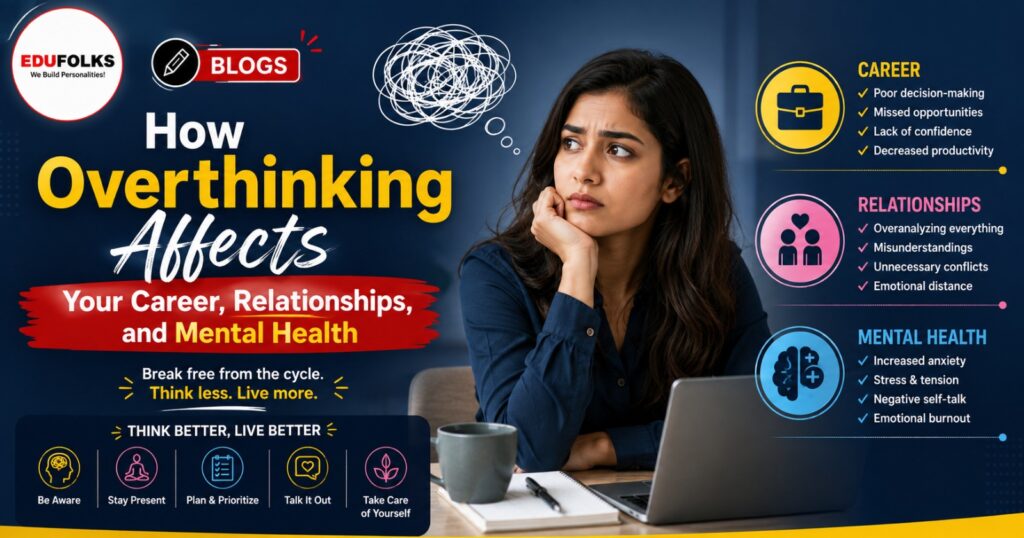
How Overthinking Affects Your Career, Relationships, and Mental Health
Haven’t you ever come up with the same dialogue in your head repeatedly? Are you constantly anxious about making a bad choice or thinking of the worst-case scenario before something even takes place? If you have answered any of the two questions affirmatively, it can be a sign of Overthinking Symptoms.
Overthinking is more than simply thinking deeply about a situation. It refers to the process of analyzing the issues over and over again, worrying about the future, or getting stuck in the past. Occasional overthinking is normal, but turning it into a regular habit can harm your career and personal life.
In the modern fast world, people feel pressures of being successful and living up to the expectations. The pressure one feels can become a reason for Overthinking Symptoms, which would cause stress, anxiety, making wrong decisions, etc.
At Edufolks, we believe that improving communication skills, emotional intelligence skills, and self-confidence matters as much as academic achievements and professional accomplishments. Thus, to enhance mental health, it is important to understand what causes and affects overthinking.
What Are Overthinking Symptoms?
The Overthinking Symptoms include different mental and emotional indications that reveal that you spend too much time worrying about or analyzing events.
Instead of solving the issues, overthinking usually creates new ones by increasing stress levels and reducing self-confidence.
Common Overthinking Symptoms might include:
- Constantly replaying conversations and events in your head;
- Excessive worrying about future events;
- Struggling to make decisions about even the simplest things;
- Feeling exhausted;
- Having difficulties with concentrating;
- Having serious difficulties with sleeping due to the inability to stop thinking;
- Frequent imagining of worst outcomes.
Recognizing these symptoms early can help you take steps to manage them before they begin affecting your daily life.
How Overthinking Affects Your Career.
Employing confidence, concentration, and timely decision-making is a key aspect of your career. Indeed, overthinking symptoms can turn out badly for your performance and hinder you from realizing your full potential.
Decreased Productivity
If you tend to overanalyze your work, you may end up with more talk and less action. Instead of getting things done, you spend time reconsidering your choices.
This leads to possible missing of deadlines and lowering the productivity level.
Inefficient Decision-Making
Good professionals are aware of the fact that not every decision is supposed to be right and good. Those who suffer from overthinking symptoms are afraid of making mistakes and this is why they procrastinate.
Whether it is about seeking new positions, accepting a promoted role, or suggesting new ideas, overthinkers usually fail to do anything.
Mounting Stress at Work
Feeling worried about your achievements, appraisal or future career prospects leads to unnecessary stress. Over time, stress reduces your motivation and makes your job unbearable.
Rather than enjoying a new opportunity, you waste your time overanalyzing past failures.
Lack of Confidence
Often being accompanied by overthinking, self-doubt can lead one to have doubts about one’s own abilities at times when one is, in fact, perfectly competent to perform a task or take up a position. This insecurity can create difficulties for a person when they want to speak up in meetings, take leadership positions, or try for a better job.
Edufolks offers courses in personality development and communications aimed to enhance one’s confidence and eliminate self-doubt and thus improve performance at work.
How Overthinking Affects Relationships
Trust, communication, and understanding are the keys to a healthy relationship. Unfortunately, one of the problems with overthinking is that it can create a lot of misunderstandings.
Misunderstanding Conversations
Have you ever wondered why someone hasn’t replied to your message right away?
Overthinkers always think that there is something wrong when there might be a logical explanation.
When people overanalyze conversations, they create problems that do not exist.
Trust Issues
Overthinking leads to unnecessary suspicion.
Instead of trusting a partner, friend, or family member, one tends to think of bad scenarios without any proof.
Communication Problems
People who tend to overthink are often reluctant to express their thoughts and feelings because they fear saying something wrong.
Consequently, important conversations are postponed, misunderstandings become more frequent, and emotional gap develops.
Learning communication skills can help solve the problem.
Emotional Drain
Getting tired is a cause for much concern. One endlessly worries about their relationships and makes a mess of their brain. It is all about thinking of things that have not been answered yet and worrying about something they imagine and that never happens. All this nun-draining of brain leads to sadness and problems in the relationship they have with other people.
How Overthinking Affects Mental Health
Overthinking has many effects, but perhaps the most concerning impact is on mental well being. Ignoring Overthinking Symptoms for a long time can impact your emotional well being and quality of life overall.
Heightened Anxiety
Increased anxiety is one of the strongest links between overthinking and anxiety. The more probable you make negative situations, the more anxious you will be. This can lead you to feel overwhelmed in even small situations, as your brain is constantly thinking of what was worst-case scenario.
Chronic Stress
While stress is a normal reaction to challenges in life, overthinking puts your body in a state of tension which continues.
This constant state of stress can lead to health problems, both physical and emotional. Common signs are: headaches, fatigue, muscle tightness, irritability and lack of concentration.
Sleep Problems
A lot of individuals who deal with Overthinking symptoms find it difficult to go to bed because their mind is excessively active at night hours. Instead of calming down, they keep repeating conversations over and over again, thinking about tomorrow, or concern themselves with unresolved issues. Poor sleeping quality increases distress and affects the ability to work effectively during the day.
Reduced Self-Esteem
Overthinking causes people to pay more attention to negative moments than to successful ones instead of recognizing their achievements. Instead of being satisfied with their performance, individuals keep blaming themselves for any minor mistakes. Eventually, such behavior harms one’s self-esteem and vice versa.
Why Do People Overthink?
Comprehending the cause of any issue is imperative in order to successfully manage Overthinking Symptoms. Common reasons are:
- Fear of failure
- Perfectionism
- Low self-esteem
- Bad memories
- Fear of judgment
- Doubts regarding future activities
- Being pressured academically and at work
- Being socially compared through social platforms
Recognizing the underlying reason for your condition is the first step toward achieving concrete solutions.
Can Overthinking Be Controlled?
The answer is affirmative.
Though you might not be able to entirely eliminate all negative thoughts, you can learn to control your reactions and avoid letting overthinking take over your life.
Through self-awareness, develop healthy habits, communicate positively, and seek expert support if needed, say bye to Overthinking Symptoms and form a healthier mindset.
Edufolks advocate the development of communication skills, confidence, emotional intelligence, and personal development among individuals so that they handle the different challenges life throws at them successfully.
Practical Ways to Stop Overthinking
The good thing is that overthinking symptoms can be handled with constant practice and proper habits. While you may find it impossible to have no negative thoughts, it is possible to teach you how to react to these thoughts in a better manner.
1. Concentrate on things you are able to change.
Many people waste precious time worrying about things they cannot control. Instead of thinking about “what can happen”, think of what you can actually do right now.
For instance, instead of awaiting the outcome of a job interview, you can spend your time improving your knowledge and skills, which will relieve stress and give you self-assurance in your abilities.
2. Put a limit on the length of time spent thinking about decisions.
People who overthink tend to postpone making a decision because they want everything to turn out perfect.
Set yourself a realistic time limit for making decisions. After collecting enough information, trust your judgement.
3. Practice Mindfulness
Mindfulness allows you to concentrate on the present as opposed to worrying about the past or the future.
Engaging in simple tasks like meditation, deep breathing, or even taking a brief walk without having any distractions can help quiet your mind and prevent Overthinking Symptoms.
Taking only 10-15 minutes a day to practice mindfulness can enhance emotional well-being and help you cope with everyday anxiety.
4. Write Down Your Ideas
Sometimes thoughts can feel overwhelming due to the fact that they exist only in your mind and this leads to confusion.
Journaling assists in organizing thoughts and figuring out if the concerns you have are valid and not just opinions. Moreover, writing helps identify thought patterns that keep appearing and gives room to practical solutions.
5. Avoid Constant Social Comparison
Social media usually highlights only the good aspects of others’ lives. Seeing others’ successes creates self-doubt, stress and anxiety.
Don’t compare your progress with somebody else’s achievement. Instead, concentrate on your growth.
6. Develop Self-confidence
Low confidence leads to the overthinking symptoms. Being confident in what you do helps a lot while making decisions.
Building self-confidence can be done through the following methods:
- Developing new skills.
- Making plans.
- Celebrating small wins.
- Practicing positive self-talk.
- Being a better communicator.
Edufolks offers personality development and communication courses to help people enhance their confidence, emotional intelligence, mindset and achieve progress in their personal and business life.
Daily Habits That Help Reduce Overthinking
Little changes in lifestyle may have a strong positive influence on managing the overthinking symptoms
Make sure that you instill these healthy habits into your routine:
– Engage in physical activity for at least half an hour a day.
– Have quality 7-8 hours of sleep at night.
– Avoid spending too much time on social media.
– Read books on positive thinking.
– Stay surrounded by supportive friends and family.
– Write down three things you are grateful for each day.
– Take breaks while working or at study.
– Solve one problem at a time instead of thinking about all issues at the same time.
These habits allow you to ensure your well-being in both mental and emotional aspects over time.
When Should You Seek Professional Help?
It is normal to have occasional overthinking. However, when overthinking becomes so excessive that it starts to negatively affect your work life, relationships, sleeping patterns, and overall daily routine, it might be a good idea to seek help. If you notice any of the following symptoms, it might be a good idea to consult a mental health professional.
- Persistent worry or anxiety.
- Inability to sleep well for weeks.
- Experiencing panic attacks.
- Loss of interest in usual daily activities.
- Difficulty focusing on daily tasks.
- Feeling emotionally overwhelmed.
Reaching out for help does not mean you are weak, but rather you are actually taking a step towards improving your mental health.
Conclusion
We all encounter unwanted thoughts from time to time. However, giving those thoughts power over you and your life can disturb your happiness, confidence, and career success. Awareness of Overthinking Symptoms can be useful in the early stages, as it allows people not only to recognize them but also to make changes before they create any trouble in their careers, relationships, or mental health.
It is important to understand that progress comes from the act of doing, not from considering all possibilities. Therefore, focus on the aspects you can control, build healthy habits, keep up good communication, and seek help of people when needed.
At Edufolks, we believe that personal development also includes development of personality traits. We offer programs in personal development, communications skills, and confidence building to help people gain emotional resilience necessary for overcoming failures, reducing self-doubt, and having a better future.
If you are going through the process of Overthinking Symptoms, start with little changes today. Any positive step takes you closer to better mental health, stronger relationships, and successful career.
FAQs
1. What are the major signs of Overthinking?
Recurrent Overthinking Symptoms may involve repeating several previous occurrences over and over, enduring tension related to the future, trouble with arriving at a decision, loss of attention, sleep disruptions, burnout, and feeling negative about numerous situations
2. Is my job affected by Overthinking?
Sure! The state of being an over-thinker can impede action-taking, slow finding solutions to issues, undermine self-esteem, elevate stress levels at the workplace, and affect numerous career-related choices.
3. How is Overthinking harmful for the relationships?
Overthinking can lead to confusion, distrust, lack of connection, and human misunderstandings because of sticking to assumptions rather than actual facts.
4. How do I naturally prevent overthinking?
There are a few natural ways to overcome overthinking, including practicing mindfulness, staying physically active, journaling, avoiding excessive social media activity, boosting one’s self-esteem, concentrating on solutions rather than problems, and following a healthy lifestyle.
5. When is it a good idea to use professional services?
If the condition is affecting your sleep, work, education or relationships, or is causing anxiety and other emotional distress, you may want to get in touch with a health professional. This way, you will learn how to cope with this state.