
Business Communication Skills: The Complete Guide to Professional Success in 2026
With today’s highly competitive global marketplace, it is not enough for people to have only the technical skills required to do a job in order to be successful in their careers. Employers are putting increasing emphasis on the need for employees who have strong oral and written communication skills; can effectively work with other employees in a collaborative manner; and develop and maintain quality professional relationships.
Thus, the development of Business Communication Skills is critical to career success.
Strong business communication skills are essential, regardless of your current work status—for example, if you are a student preparing for your first job; a working individual seeking out greater success in your future career; or an entrepreneur with your own business. In 2026, employers will place a premium on the creation of communication-focused workplaces where their employees are encouraged to communicate with one another by sharing new ideas, working together to solve issues, and collaborating effectively across their respective teams.
This guide provides an in-depth look at why developing business communication skills is so important; the benefits of acquiring and improving your business communication skills; the components of business communication skills; and how to develop your business communication skills by taking advantage of professional learning opportunities such as Business Communication training or a Business Communication Course.
What Are Business Communication Skills?
In a Workplace or Business setting, Business Communication Skills refer to how well you can communicate (exchanging messages) in an effective and professional way. Business Communication Skills include; Verbal Communication, Written Communication (must be able to write clearly and grammatically correctly), Listening Skills, Presentation Skills, Negotiating Skills, Interpersonal Communication Skills and Digital Communication Skills.
Professionals benefit from Effective Communication in the following ways:
– Clearly communicating your ideas to others
– Building trust with co-workers and clients
– Improving teamwork and cooperative working relationships
– Quickly and effectively resolving conflict
– Increasing productivity
– Establishing professional relationships.
Communication in today’s workplaces isn’t limited to in-person discussions. All employees are required to communicate effectively (exchanging information) via e-mail, video conferencing, presentations, text-based messaging, and collaboration tools.
Why Business Communication Skills Matter in 2026
The workplace has seen considerable changes as a result of the growing number of organisations that are now operating remotely, employing hybrid workers and collaborating with businesses worldwide. In this increasingly interconnected world, effective business communication skills is equally as important for the continuity of business operations as are the workplace itself and the various stakeholders involved in those operations.
Why are business communication skills so important?
1. Improved Workplace Productivity
Effective communication reduces the potential for errors or misunderstandings between employees based on poor communication so that employees are able to do their jobs correctly. When expectations and instructions are communicated clearly between employees and teams, work efficiency increases.
2. Improved Team Collaboration
Successful teams are built on successful communication; if employees communicate effectively, they are better able to share knowledge, coordinate their projects and provide assistance to the other members of their team.
3. Improved Leadership
Strong communicators are often very effective leaders in their teams. Strong leaders create positive work environments, provide constructive and helpful feedback and motivate and inspire their members through effective communication.

4. Stronger Client Relationships
Businesses are able to expand their growth and expansion through the effective communication of their products or services based upon their understanding of the needs of their customers. By effectively communicating to their clients, strong communicators develop trust and loyalty, which increases customer satisfaction.
5. Increased Opportunities for Career Advancement
Effective communication is among the most highly regarded competency sets by employers. Employees who communicate effectively tend to have increased opportunities for promotion and advancement in the workplace.
Essential Components of Business Communication Skills
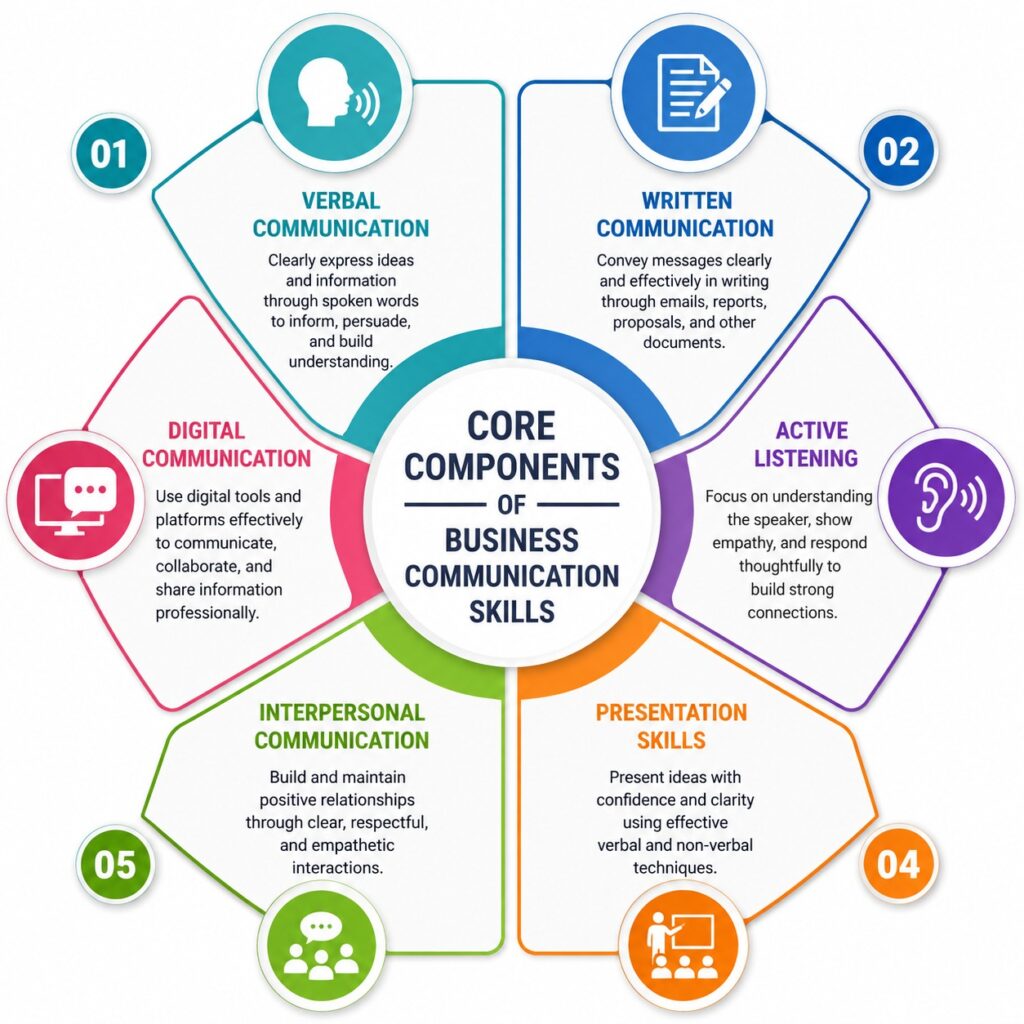
1.Verbal Communication
The way we speak – including articulation, confidence and professionalism – is part of how we communicate verbally. This includes everything we do in meetings, conversations, interviews and communicating with clients.
In order to be effective in verbal communication, you need to do the following:
– Pronounce words clearly
– Use an appropriate tone
– Have confidence
– Use professional language
– Be concise
2.Written Communication
Written communication is very important in business environments and includes emails, reports, proposals and presentations; all should be focused and easy to read or comprehend.
The key elements of effective written communication include:
– Using proper grammar
– Having a professional tone
– Being logically organized
– Being clear and accurate
– Writing for the audience
3. Active Listening.
Communication, as with speaking, involves listening actively. By listening carefully to others when they speak, you will gain a greater understanding of the speaker, and be better able to respond appropriately.
Active listening consists of:
– Presently and listening fully
– Listening without distractions
– Asking meaningful questions
– Responding thoughtfully
4. Presentation Skills
As a professional, presenting ideas on behalf of your organization is an everyday task. It is critical that you are able to present your ideas to coworkers, clients, and stakeholders, and that you are confident when doing so.
Primary characteristics of strong presentation skills include:
– Confidence in public speaking
– Being able to engage your audience
– Using visual aids effectively
– Communicating your message clearly
5. Interpersonal Communication
The purpose of interpersonal communication is to foster and maintain positive relationships with others. Building quality relationships with coworkers creates more productive teams and improve overall workplace productivity.
6. Digital Communication
With today’s workplaces becoming increasingly connected by technology through mediums such as video conferencing, emails, messaging platforms and collaboration tools, having an understanding of digital etiquette is essential for success in the workplace.
Common Business Communication Challenges.
Most employees, although aware of the significance of communication, regularly experience problems related to communication, such as:
1. Lack of Clarity
Unclear communication has been blamed for creating confusion, making mistakes, and creating delays.
2. Poor Listening Skills
Not actively listening can create misunderstandings and hinder collaborative efforts.
3. Communication Anxiety
Many gain anxiety when giving presentations, attending meetings or speaking in public.
4. Cultural Differences
In an increasingly global workplace, Employees must communicate effectively in a way that will communicate with others from a variety of cultures.
5. Digital Communication Issues
Misunderstanding an email, or message via digital media can create confusion and conflicts in the workplace.
The first step to improving the effectiveness of communication is recognizing that these challenges exist.
How to Improve Business Communication Skills
1.Practice Active Listening
Close your eyes and listen intently to the person speaking to you; paying attention while they are talking increases the likelihood of understanding them, as well as helps develop better working relationships with them.
2.Build Your Vocabulary
Having a big vocabulary makes it easier to communicate your thoughts or ideas clearly and with more confidence.
3. Practice Your Writing
You should be writing emails, reports, or any other formal correspondence consistently.
4.Get Feedback
Get constructive criticism from others who are more experienced than you (mentors, coworkers, etc.) about your strengths and weaknesses when it comes to communication.
5.Join A Group Discussion
Being involved in a group discussion will improve your self-confidence, critical thinking skills, and your ability to communicate interpersonally.
6.Improve Your Public Speaking Ability
Any opportunity you can find to speak publicly will help you become more comfortable speaking to large groups of people about your ideas.
Benefits of Business Communication Training
Professional business communication training will allow individuals to improve their practical communication abilities that can be used within the work environment at any time during their career.
Benefits of Professional Business Communication Training
- Clearly articulate thoughts verbally
- Increase confidence in the workplace
- Improve one’s leadership skills
- Become more effective presenters
- Increase professionalism when composing e-mail
- Learn how to resolve conflict effectively
- Enhance the quality of interactions with customers
Many organisations provide communication training because they have come to understand the importance of communication and how it directly affects both productivity and business success. At Edufolks, learners participate in practical communication exercises, presentations, and workplace simulations that help them develop strong business communication skills.
Why Enroll in a Business Communications Course?
A Structured in Business Communication Course embraces a fully-integrated approach to learning and develops the ability of participants to communicate effectively as professionals.
What You Will Learn in a Business Communication Course:
Through a well-structured business communication course, you will learn:
- Professional Speaking
- Writing for Business
- Use of E-mail
- Presentation of Ideas
- Workplace Interview
- Use of Communication Strategies within the Workplace
- Working as a Team to Achieve a Goal
- Leadership Skills
Completing a business communication course, will provide the student/professional with the confidence to succeed and increase their performance in the workplace.
Business Communication Skills for Students
English language proficiency, verbal communication, written communication, and pronunciation are key components of effective job searching.
Benefits of developing your business communication skills include:
– Enhanced performance during interviews
– Greater confidence in presenting information
– Improved group discussion abilities
– Greater confidence
– Improved networking ability in academics and the workplace
Developing strong communication skills will also give you an edge over other applicants in today’s job market.
Future of Business Communication Skills
Even as workplaces evolve through the integration of technology via AI, automation, and digital transformation, it’s likely that communication skills will have a greater importance in the future.
Technology may automate numerous tasks, but the ability for humans to communicate will still be an important aspect of:
- Leadership
- Relationship building
- Negotiation
- Problem-solving
- Collaboration within teams
- Engaging with customers
In the future job market, individuals that are able to combine their technical skills and strong communication skills will be in high demand.

Conclusion
In the year 2026, Business Communication Skills will be one of the most significant professional skill sets available in the workforce. They will impact an individual’s ability to advance in their career, the amount of productivity they can contribute to their workplace, the effectiveness of their leadership, and the overall success or failure of a business. Therefore, as a student, employee, entrepreneur or manager, you should invest in developing your communication skills because you are likely to reap the long-term benefits that come from having good communication skills.
By taking part in business communication training or by being enrolled in a complete business communications course, a person can help improve their self-confidence and improve the quality of their relationships at work, while also helping to meet their career aspirations.
In today’s world; which continues to become more connected and competitive; strong business communication skills are necessary for success in all aspects of one’s career. Whether you are a student or a working professional, Edufolks can help you build the communication skills needed to succeed in today’s competitive workplace.
FAQs:
The term Business Communication Skill refers to the various abilities that a person utilizes to communicate with people in a professional manner, in an effective manner. There are many different types of business communication skills; verbal, written, listening, presenting, and Interpersonal communication.
Business Communication Skills can help to improve many different aspects of business; productivity, teamwork, leadership effectiveness, customer relations and ultimately your own career advancement.
A structured business communication training program is one that has been developed for the purpose of helping individuals to enhance their workplace skills; speaking, writing, presenting, listening and engaging professionally with coworkers.
Anyone who wants to improve their workplace communication, whether a student, job seeker, employee, manager, entrepreneur or otherwise would likely benefit from enlisting in a Business Communications Course.
You can improve your communication skills through consistent practice, becoming a good listener, taking Public Speaking opportunities, obtaining Professional Development training, or registering in a Business Communications Course.