
Body Language Tips for Interviews: How to Create a Strong First Impression
Interviewing starts well ahead of actually responding to the first query. The body language of a candidate sends signals about his/her confidence, professionalism, and attitude right when he/she walks into the room or logs into the interview. Studies have proved time and again that non-verbal cues are very effective in forming first impressions. Therefore, it is very much important for job seekers to keep in mind what they say during the interview but rather how they represent themselves.
It is both technical knowledge and communication skills that are needed; however, the recruiters take notice of everything including the posture, eye contact, expressions on the face, gesticulation, and confidence level of a candidate. All of the above-mentioned things could help recruiters in understanding how reliable, capacitated, and excited a candidate is during the interview.
By following the Body Language Tips you will be able to form a good impression of yourself before the interviewer and get rid of interview anxiety.
Why Does Body Language Matter in an Interview?
Apart from showing your qualifications to the interviewers, they also look for your level of confidence, professionalism, and the way you carry yourself in the interview.
The right body language will provide you with the following benefits:
- Establish credibility
- Show confidence
- Reflect interest in what you are saying
- Enhance communication ability
- Create a great first impression
Don’t forget, negative body language may be inadvertently interpreted as lack of confidence, disinterest or poor timeliness.
1. Make a Confident First Entrance
From the moment you step into the room, you are already being interviewed.
As you walk in, make sure to:
- Keep your back straight;
- Smile friendly;
- Walk in a relaxed manner;
- Keep your shoulders relaxed;
- Keep calm body behavior.
Never rush, always keep your head up and avoid looking like you are distracted.
This way, the first impression you create will be a positive one.
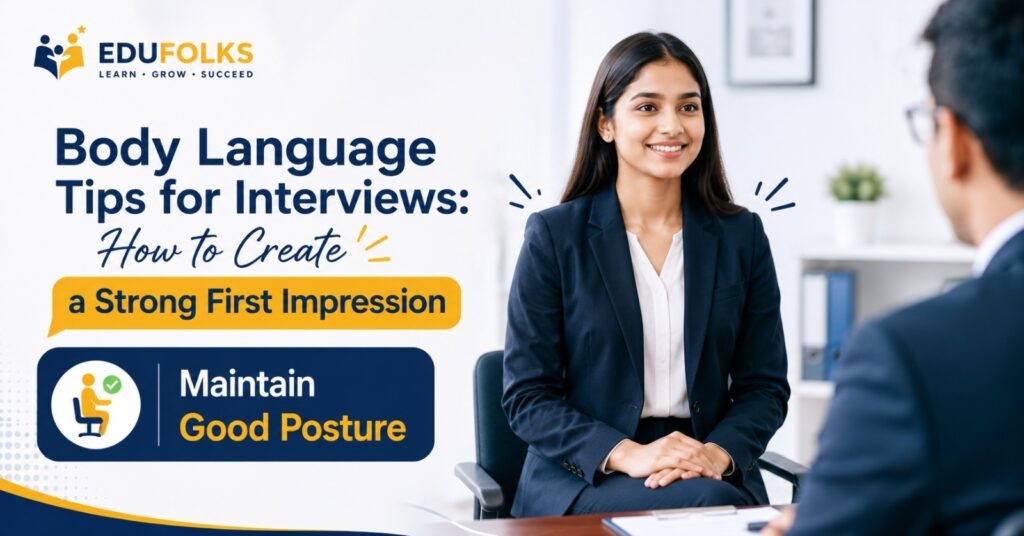
2. Keep Good Posture
You should know that maintaining good posture is also one of the most important body language tips.
- You have to sit like this:
- back straight;
- Shoulders relaxed;Your
- Feet are flat on the floor;
- Your hands can be on your lap or the table.
While sitting, the following should be avoided:
- Being slouched;
- Leaning far back;
- Keeping your arms crossed tightly;
- Moving around in your chair too much.
Correct posture shows your confidence, attentiveness, and professionalism.
3. Make Natural Eye Contact
- Eye contact is a sign of being confident and honest.
- While during the interview, make sure to:
- Be looking at the interviewer while listening to him/her;
- Maintain eye contact when you are talking;
Look away occasionally not to make it look as if you are staring.
Avoid:
- Looking down on the floor;
- Looking around the room all the time;
- Only staring at your resume;
- Staring without blinking.
Proper eye contact is the best way to build trust and get the interviewer engaged.
4. Smile Naturally
A true smile gives an impression of approachability, confidence, and enthusiasm.
- Smile when:
- Greet the interviewer
- Introduce yourself
- Share your achievements
- Wrap up the conversation
Avoid forcing a big smile throughout speaking. Genuine smiles help to build solid connections.
5. Use hand movements carefully
Natural gestures help to improve the engagement during your communication.
Use gestures to highlight important moments but avoid too many movements.
Good practices include:
- Keeping your palms visible
- Using moderate hand gestures
- Let your hands have a rest when you do not speak
Avoid:
- Pointing
- Fiddling with a pen
- Cracking fingers
- Having nervous habits like fidgeting.
Controlled hand movements communicate self-assurance.
6. Refrain from Displaying Nervous Behaviors
Some job interview candidates tend to exhibit nervous tendencies and actions during their interviews without realizing that they are doing so. Some often displayed habits include –
- Tapping feet
- Moving legs
- Playing with the face
- Nail biting
- Adjusting the attire frequently
- Playing with pens
Observing yourself during the mock interviews can help you identify these distractions and mitigate such actions on your part.
7. Show Active Listening
Interviewers value people who pay attention.
Here’s how to do active listening:
- Nod when necessary
- Look at the other person’s eyes
- Smile when necessary
- Do not interject
- Listen and respond thoughtfully
These gestures show respect and also interest in what they are saying.
8. Have a Positive Face
Your face does speak even before your speech.
Your facial expressions should reflect:
- Interest
- Confidence
- Curiosity
- Enthusiasm
- Professionalism
You should not suggest boredom, confusion, impatience or frustration.
A positive face will make the conversation more interesting.
9. Maintain a Professional Space
It is very important to have a professional space during interviews.
You should keep a certain distance.
If conducting a video interview, make sure you sit at a comfortable place where your face and upper body would be visible clearly.
10. Conclude It with Confidence
The ending is as important as the introduction.
- When concluding the conversation:
- Thank the interviewer sincerely.
- Show your winning smile.
- Get up calmly from your chair.
- Shake hands, if it is appropriate.
- Maintain the eye contact.
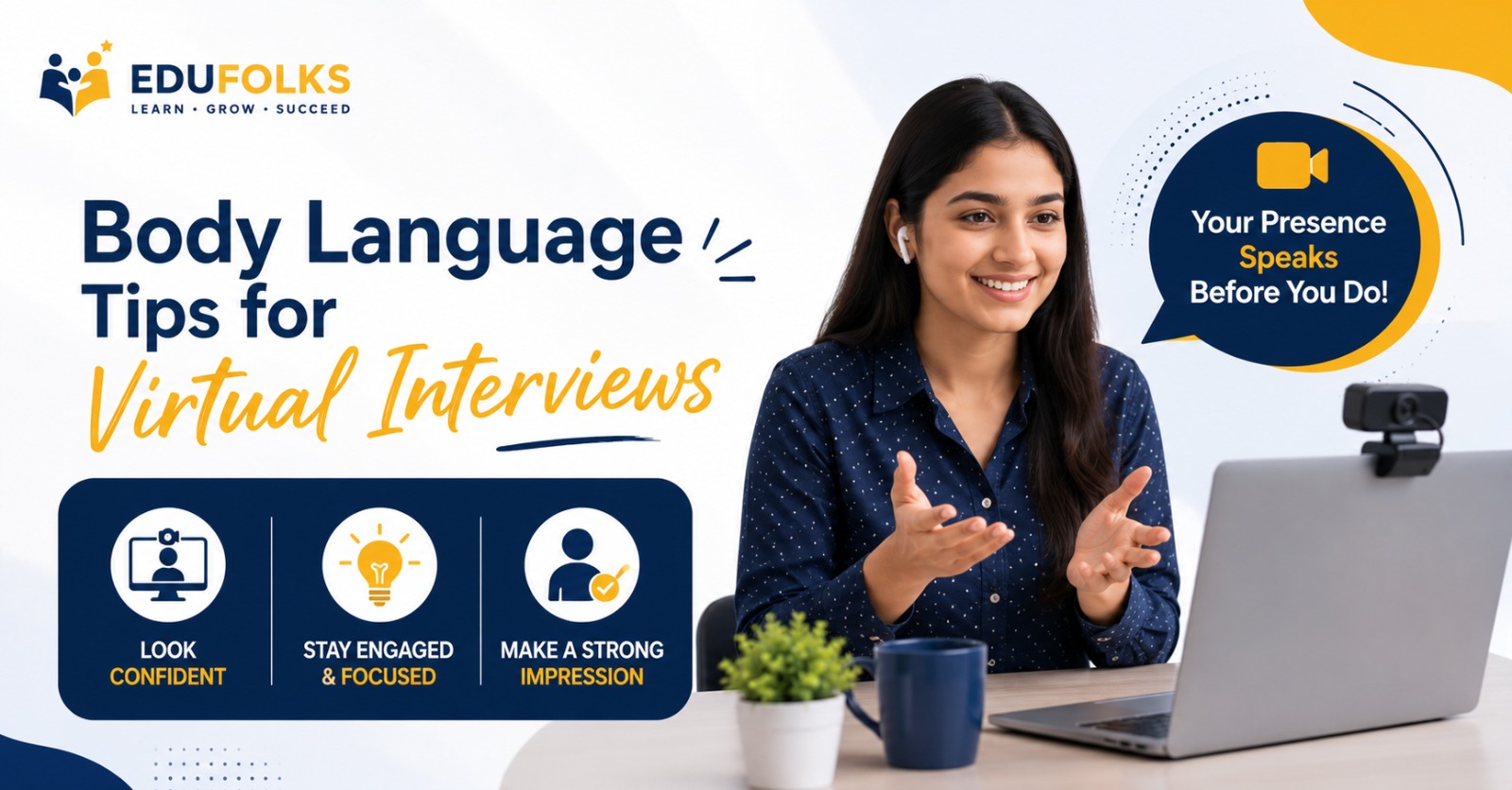
Body Language Tips for Virtual Interviews
The online interviews should have the same level of professionalism as it is seen in the case of face-to-face interviews, so here are some body language tips that need to be kept in mind while taking the online interview.
Try to focus on the camera instead of on the screen when you talk.
- Make sure that you are sitting in an area that is well lit.
- Keep your camera at eye level so that it captures your face accurately.
- Ensure that there is no clutter seen in the background.
- Be sure to dress properly and in a professional manner.
- Do not keep looking at your phone and the other screens.
- Try to keep your microphone off when you are not speaking.
Common Body Language Mistakes to Avoid
The candidates have no power to ensure the positive outcome of their interview because of their negative body language.
Don’t make these mistakes:
- Slouching
- Crossing the arms
- Not looking into the interviewer’s eyes
- Using low tone of voice
- Too much hand movement
- Shuffling
- Getting distracted
- Monitoring the watch or phone
- Making Grumpy faces
- Not saying thank you after the interview
If you know about these behaviors of yours, the next step is to change them on positive body language.
How to Practice Positive Body Language.
Enhancing body language needs continuous practice.
Some good ways to do this include:
- Practicing before the mirror.
- Recording the rehearsal for an interview.
- Monitoring your body language.
- Ensuring eye contact while communicating.
- Getting suggestions from your supervisors.
- Joining in discussions with the group.
Through repeated practice, you will gain confidence in what you are doing.
How Edufolks Helps Students Prepare for Interviews
Edufolks believes that success in interview relies on two things namely techniques and presentation. That is why our modules of preparation for interviews are focused on communication skills as well as personality development.Edufolks provides the following types of training:
- Mock interview practice
- Personality development
- Communication training sessions
- Public speaking practice
- Group discussions
- Resume preparation
- Confidence building sessions
With individual mentoring and skills development exercises we help students gain good interview skills and create lasting impression.
Conclusion
Establishing a good first impression has to do with much more than just dressing in formal clothes and answering questions in the right way. Body language indicators like posture, eye contact, facial expressions, gestures made during the conversation, and overall confidence say as much as the spoken message.
The tips shared in this piece can be useful in working on your body language to have an image of a confident and resourceful worker ready to perform tasks related to the new position.
Utilizing such skills during internship interviews, campus placements, or job interviews will give you a competitive edge over other candidates and will help land a job of your dream.
FAQs:
Body language helps interviewers assess your confidence, professionalism, communication style, and enthusiasm. Positive non-verbal communication creates a strong first impression and supports your verbal responses.
Some of the most effective Body Language Tips include maintaining good posture, making natural eye contact, smiling confidently, using controlled hand gestures, actively listening, and avoiding nervous habits like fidgeting.
You can appear more confident by sitting upright, maintaining eye contact, speaking clearly, smiling naturally, using positive facial expressions, and practicing mock interviews before the actual interview.
Avoid slouching, crossing your arms, avoiding eye contact, excessive hand movements, checking your phone, tapping your feet, touching your face repeatedly, or appearing distracted during the interview.
Edufolks offers interview preparation programs that include mock interviews, personality development, communication skills training, public speaking, confidence building, career counselling, and professional etiquette coaching to help students perform confidently in interviews
