
Top 15 Soft Skills for Students That Employers Want in 2026
In the fast-changing workplace today, academic credentials are not enough to get a job or advance in one’s career. Many employers are now looking for candidates who have strong interpersonal skills, are adaptable, and have good communication skills. Because of this,Soft Skills for Students have become very important to employers in determining whether or not they will hire someone and how well they will do in their jobs.
Many companies now use computers for many of the tasks that they need to complete; therefore, employers want to find individuals who can work collaboratively, come up with innovative solutions to problems, and communicate clearly and with confidence. Thus, no matter what students do today to prepare for their future (internship, campus placement, continuing education, or employment), acquiring soft skills will give students a distinct advantage when competing against their peers.
This article will outline the top 15 Soft Skills for Students that every employer will look for by 2026; it will also describe how soft skills training for students will help students develop the various skills.
What Are Soft Skills?
Personal attributes and interpersonal abilities that allow an individual to develop positive relationships with others and be successful in all aspects of life (working and studying) are referred to as soft skills.
Soft skills differ from technical/hard skills because they emphasize how an individual communicates, cooperates with others, problem solves, and reacts to different situations. Soft skills include the following:
– Communication
– Leadership
– Teamwork
– Time management
– Problem solving
– Flexibility/adaptability
– Emotional Intelligence.
The developing soft skills in students has been a primary focus of many colleges and universities in recent years. Companies are looking for employees who have the skill set of a well-rounded professional and are able to work successfully in today’s constantly changing workplaces.
Why Are Soft Skills Important for Students?
Soft skills can benefit students in many ways:
- Increasing performance at work interviews
- Developing self-confidence
- Improving the overall performance in school
- Establishing Leadership in Groups
- Improving Teamwork Skills
- Helping Them Deal With Problems in Their Workplaces
Making them More Attractive Candidates for Employment Opportunities among Potential Employers
In light of Soft Skills for Students being equally important as Academic Achievement, many Employers look for them when hiring New Employees.
Top 15 Soft Skills for Students That Employers Want in 2026
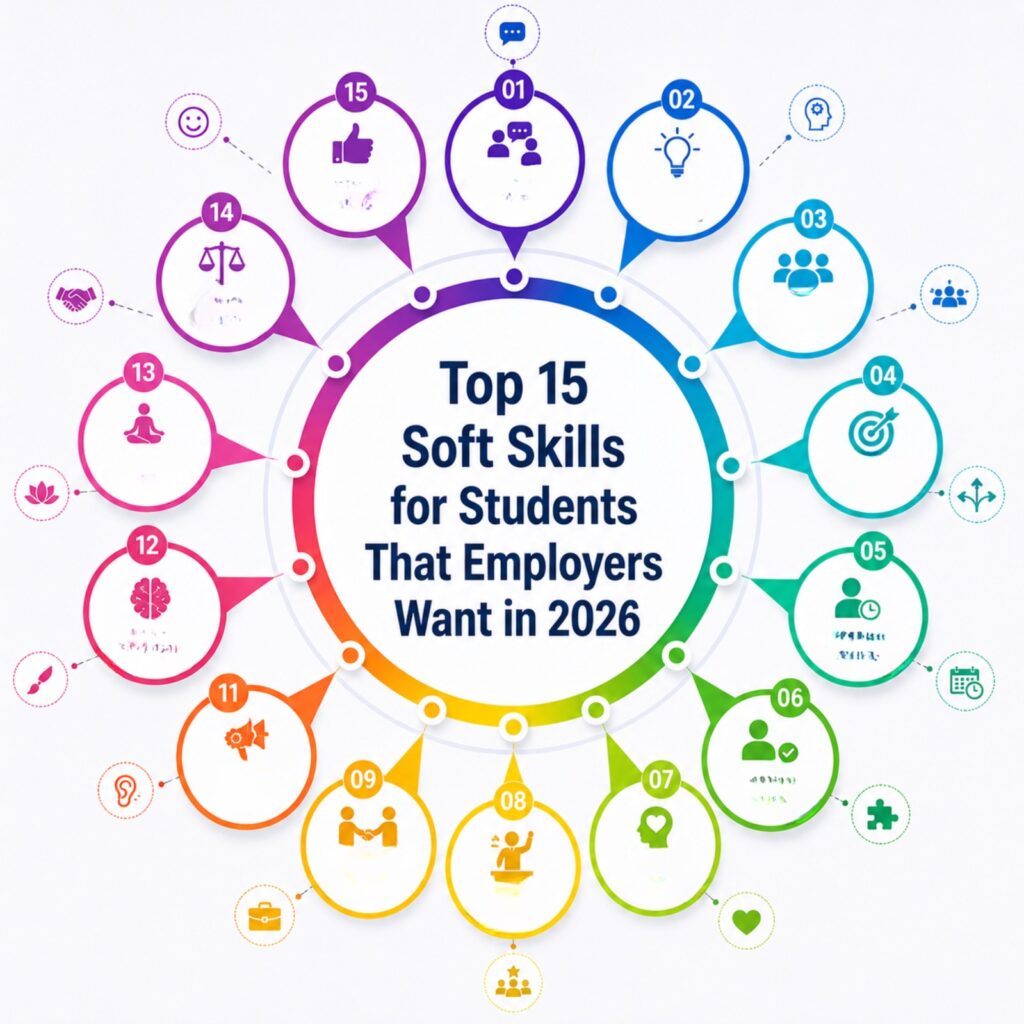
1. Communication Skills
Among the various Soft Skills for students are required to develop, effective communication remains one of the most important.
Students need to learn how to:
- Articulate their ideas clearly
- Engage in dialogue
- Compose formal emails
- Give presentations with confidence
Having excellent communication skills is essential for achieving academic and professional goals alike.
2. Teamwork and Collaboration
Teamwork is integral to the modern workplace, so employers are looking for candidates who can collaborate with other people from different backgrounds. Good teamwork includes:
- Respecting differences of opinion
- Sharing the workload
- Working toward the same team goals
- Resolving conflict in a positive way
3. Problem-Solving Skills
Employers value employees who can identify problems and create practical solutions to them. Students should develop problem-solving skills by doing the following:
Assessing situations
- Critical Thinking
- Analyzing Options
- Making Confident Choices
Problem-solving is a major aspect of the Soft Skill development process.
4. Critical Thinking
Being able to think critically will help students to objectively evaluate information and make logical choices. Students that can think critically can:
Determine the validity of information
- Challenge existing beliefs
- Create new ideas
- Make better decisions
5. Adaptability
Change is always happening in the workplace due to changing technology and marketing practices.
Adaptable students will:
- Be able to learn new things quickly
- Embrace change when it occurs
- Adjust to new environments
- Remain productive during periods of uncertainty
6. Time Management
One way students can keep their commitments to school, work, volunteering, and family is through good time management. Time management can help students with:
- Higher productivity
- Lower levels of stress
- Being better organized
- Having better grades
- Becoming more effective
7. Leadership Skills
Today, most people think of leadership as only being part of a leadership position at work. However, many employers are looking for people who are able to make decisions and inspire other people to do the same.
Some skills associated with leadership are:
- Decision making
- Taking on responsibility
- Motivating others
- Accountability
8. Emotional Intelligence
Emotional intelligence is the capacity to understand and manage one’s own emotions; and to recognize and influence the emotions of other people.
- Someone who has strong emotional intelligence can:
- Build positive relationships with other people.
- Effectively cope with stress.
- Conflict resolution.
- Communicate in a way that shows empathy to others.
9. Creativity
The ability to be innovative is the most important soft skill for students, as businesses are looking for individuals who can think creatively to help them to grow their business.
- Creative thinkers will:
- Think of new ideas.
- Improve upon existing processes (the way things are done).
- Develop new ways to solve problems.
- Contribute unique perspectives on issues.
10. Interpersonal Skills
Interpersonal skills are used to help students develop positive relationships with classmates, faculty members, and future co-workers.
Interpersonal skills include:
- Listening well.
- Communicating with respect.
- Working together as part of a group.
- Establishing networks of contacts.
11. Public Speaking
Employers value public speaking confidence very highly in candidates when hiring.
A student who can communicate his/her ideas clearly will likely be successful in the following places:
- Interviews
- Group Discussions
- Meetings
- Leadership
12. Decision-Making Skills
A student who makes effective decisions will be able to assess alternative options and select the best course of action to take.
Employers want to hire an applicant who:
- Can assess the risks of an action
- Can evaluate the potential outcomes of an action
- Is confident in making decisions
- Will accept responsibility for their actions
13. Conflict Resolution
Disagreements occur frequently both on campuses and in business; therefore, students who can successfully resolve conflicts will contribute to maintaining effective working relationships and creating a positive work environment.
14. Networking Skills
Building a professional network is critical to developing your career. Networking provides students with:
- Access to business opportunities
- Industry-specific information
- Professional contacts
- Expanded career opportunities
15. Professionalism
Professionalism is represented by how individuals behave in both school and the workplace. Behaviors associated with professionalism include:
- Reliability
- Punctuality
- Ethical behavior
- Showing respect for other people.
Professionalism consistently ranks as one of the highest-selected Soft Skills for student by Employers when requesting employees from Student Job Seekers.
The Role of Soft Skills Training for Students
When studying, many students focus on developing their technical skills and do not work on improving their soft skills. As a result, developing these soft skills is very important, so soft skills training for students will be extremely useful for student development.
Professional development courses provide a working environment that allows students to develop/experience improvement through the following types of professional skills:
- Communication Skills
- Leadership Skills
- Interviewing Skills
- Group Discussion Skills
- Presentation Skills
- Readiness for Work
Students will develop confidence and gain skills that employers want through hands-on activities, workshops, and real-life situations. Edufolks focuses on developing essential soft skills such as communication, leadership, teamwork, and problem-solving through interactive learning experiences.
Effective Strategies for Developing Soft Skills in Students
Engage in Group Activities
Team-based projects promote collaboration, communication, and leadership growth within teams.
Join Public Speaking Programs
Workshops or clubs related to public speaking assist students to develop self-confidence in their ability to speak well in front of others and help them develop their presentation abilities.
Practice Active Listening
By practicing careful listening we enhance our ability to communicate and improve our ability to build relationships with others.
Request Feedback
The use of constructive criticism assists the student in developing their strengths and pinpointing their weaknesses.
Lead Others
Take on a leadership role within a student organisation or event or take a leadership role on a project in order to provide yourself with experience leading others.
Participate in Professional Development Training
Participating in structured professional development courses for soft skills training for students provides real-world training and experiences that will help accelerate your individual and professional development.
Benefits of Developing Soft Skills in Students
There are several additional advantages of having students developing soft skills in students such as self-esteem and confidence when looking for a job.
These benefits include:
- Increased Self-Esteem
- Increased Communication Skills
- Higher Levels of Academic Achievement
- Increased Leadership Potential
- Increased Teamwork Capabilities
- Increased Preparedness for Future Careers
- Increased Potential for Success as a Professional.
All of these skills will carry over into each student’s future careers and will help them be better individuals.
Future Workplace Trends and Soft Skills
The rise of automation and artificial intelligence continues to change the way that industries operate, which will require individuals with human-centered skill sets to become more valuable.
In 2026, employers will be searching for candidates who can demonstrate that they have:
- Proficient communication abilities
- Team collaboration capabilities
- Ability to adapt to new technologies and processes
- Ability to be flexible in their work environment
- Appreciation of other people’s feelings and emotions
Technical skills may change over time; however, strong Soft Skills for Students will remain vital to career progression and success.
Conclusion
There is a strong need for the strengthening of Soft Skills for Students today than at any other time in history. As companies become more competitive and require more technologically savvy employees, Companies are continuing to focus on hiring candidates who have both the hard skills or technical knowledge and Soft Skills or interpersonal skills to perform their jobs.
Soft Skills such as communication, teamwork, leadership, adaptability and emotional intelligence are needed for both students to achieve success academically and in their future careers. There is a tremendous return on the investment in training and developing soft skills for students that will provide them with many more options for finding employment and being prepared to work successfully when they graduate.
Students who begin to developing soft skills in students today, will have a better opportunity to succeed in both the opportunities and challenges that will be presented to them in the workplace of the future.By choosing Edufolks, students can gain the confidence and professional skills required to stand out during placements and future career opportunities.
FAQs:
Soft Skills for Students include character traits or abilities related to interacting with other people (i.e., Internet Communication), working well with others, being able to lead a group of people, being able to solve problems, and being flexible in the way that students learn or do things all contribute to their success as learners.
Soft Skills will help increase students' self-confidence, improve the way they communicate with others, prepare them for a job, help them work together, allow them to lead and prepare them for their future careers through the development of positive working relationships.
Soft Skill Training for students is an organized learning experience that provides the student with training in developing their communication skills, leadership skills, teamwork skills, presentation skills, and preparing them for the workplace.
Students can increase their Soft Skills through practice, public speaking experiences, participating in team-building activities, leadership experiences, coaching and mentoring opportunities, and enrolling in professional development courses.
Most experts believe that Communication Skills are the most important Soft Skill for students Career Success due to the impact that Communication Skills have on teamwork, leadership, job interviews, working with others in your work environment, and overall success in your career.